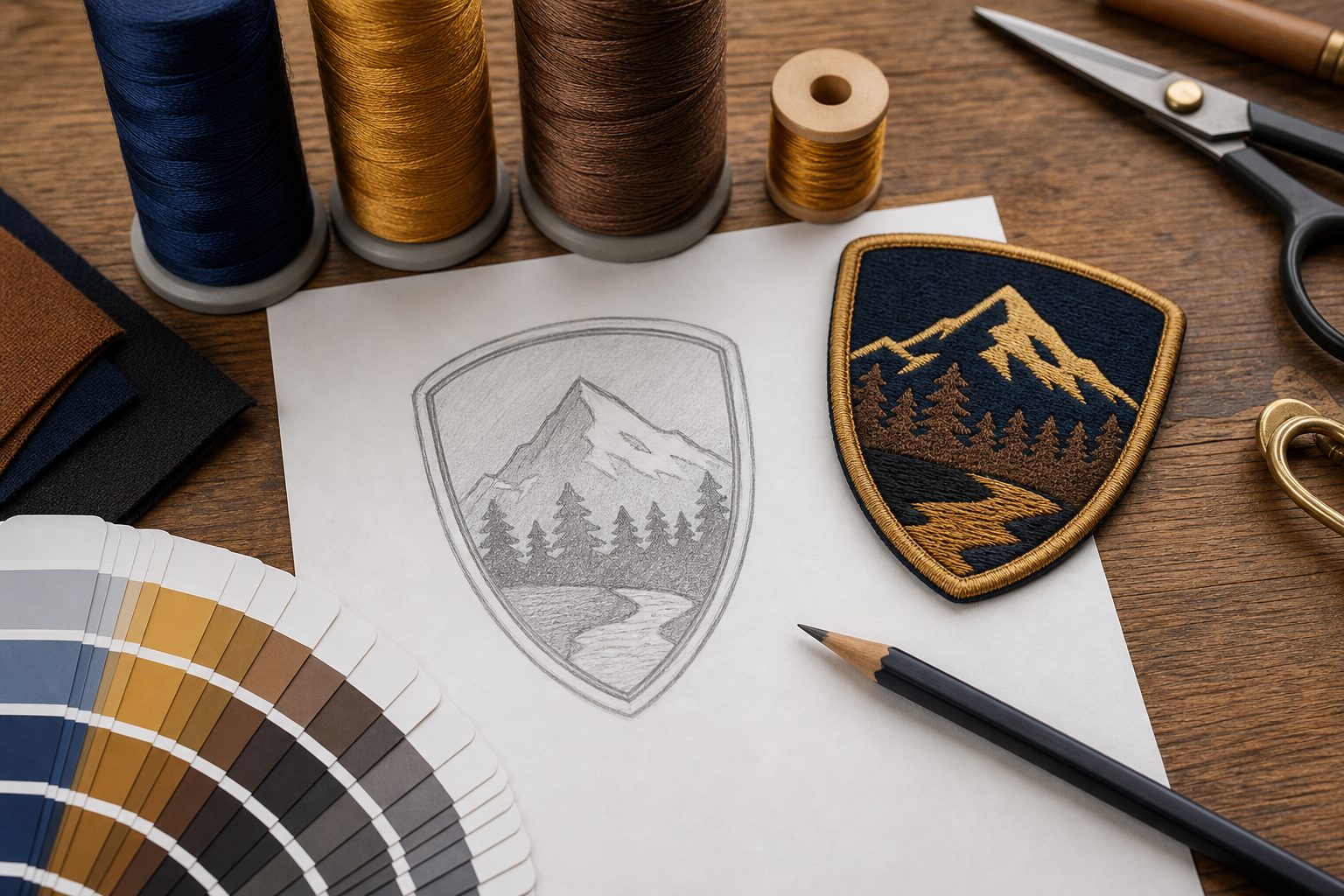
Great custom patches start with stitch-friendly art. You do not need to be a digitizer. A few design choices will make a UK order sharper, closer to the proof, and cheaper to produce. This is the brief we wish every first-time customer sent with their logo.
Whether you are building a varsity letter, a tactical morale patch, or a 2.5-inch cap logo, the same rules apply: contrast, size, file quality, and a backing that matches the garment. Skip those and even a beautiful illustration will look muddy at three inches.
File types that produce well
| File | Best for | Watch-outs |
|---|---|---|
| AI, EPS, PDF, SVG | Clean edges at any size | Outline fonts; embed or convert type to paths |
| PNG (transparent) | When you do not have vector | Need 300 DPI at final size, not a 200-pixel favicon |
| JPG | Photo-style printed patches | No tiny compression artifacts on faces or type |
| PSD | Layered print jobs | Flatten a proof copy so we see the intended look |
If all you have is a photo of an old patch, send it anyway. We can redraw and digitize. Expect extra proofing time so spelling and proportions match what you remember.
Size in inches, not pixels
Patches are quoted on the longest side. A 3-inch circle and a 3-inch wide shield are not the same amount of fill, but both start from that measurement. Caps usually want 2–2.5 inches so the patch does not fight the center seam. Jackets and bags sit well at 3–3.5 inches. Chenille letters and back pieces often need 4–5 inches so the yarn has room.
Draw at the real size or at a clean scale (for example 300% of final) so we are not guessing. Put a note in the quote: “3.5 inches wide, merrowed border, sew-on.”
Color, contrast, and Pantone
Thread and PVC both need contrast. Navy on black disappears. Gold on cream sings. For brand-critical jobs, send Pantone (PMS) numbers. We match as closely as dye lots and thread charts allow. Printed patches can hold more colors, but contrast still matters when the patch is seen from across a gym.
- Limit embroidery to roughly 4–8 solid colors when you can
- Keep a clear border color different from the fill
- Avoid hairline keylines around every shape
- Subdued tactical palettes (olive, tan, black) are a separate spec—tell us if it is field use
Type and small details
If you cannot read the motto at the size of a quarter, thread will not save it. Woven patches and printed patches handle small text better than embroidery. Script with thin strokes is a poor candidate for puff (3D) embroidery. Block sans-serif letters stitch the cleanest.
Leave a little margin inside the border. Art that kisses the merrow gets clipped or looks crowded. Think of a 1–2 mm “safe area” the way you would on a business card.
Shape, border, and backing
Circles, shields, and rectangles are efficient. Complex outlines are possible but cost more and need a clean vector path. Merrowed borders look traditional. Heat-cut and laser-cut edges suit unique shapes. Backing is not a last-minute checkbox: sew-on for uniforms, iron-on only on compatible cotton blends, Velcro for gear you will swap.
Mockup checklist before you approve
- Spelling of names, cities, and mottos
- Size in inches and overall shape
- Colors versus your Pantone or brand guide
- Border type and whether the art is too close to the edge
- Backing named on the proof (sew-on, iron-on, Velcro, etc.)
- Quantity and whether you need a second colorway later
Every quote from The Customized Patches includes a free mockup, usually within 12 hours. Changes are easy before we produce and ship UK-wide. After approval, typical production plus UK shipping is 7–12 business days.